Europe Automotive
Press transfer and EV lines need repeatable backlash, spare reducer planning and CE Machinery documentation.
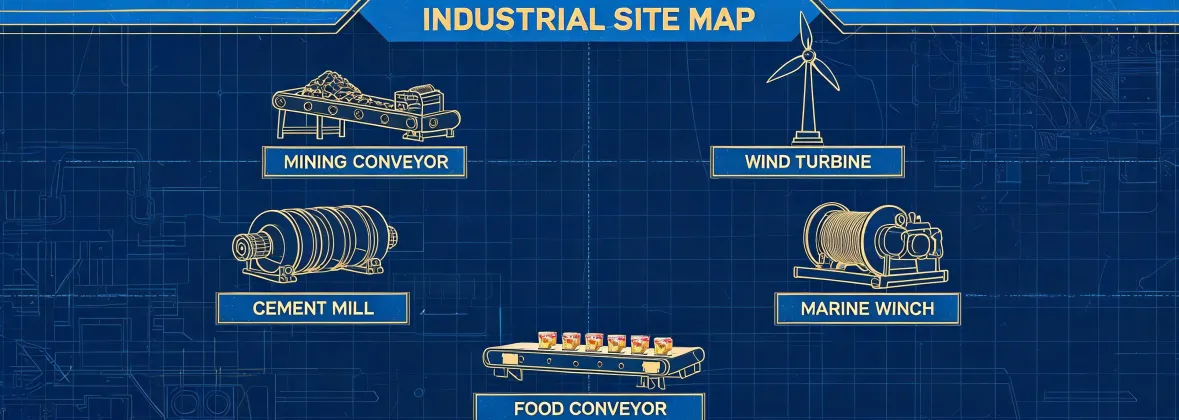
Industrial drive requirements change by region, duty cycle and maintenance culture. A mining conveyor in Western Australia has different dust, shock load and shutdown constraints than a food conveyor in Europe or a cement mill in North America. Flender gearbox programs therefore organize support by application context. The regions view helps buyers match distributor availability, rebuild capability and documentation needs without assuming one catalog answer fits every site. Each application band includes a practical drive question: required torque, input kW, output rpm, mounting position, service factor, ambient temperature, lubricant interval and whether the gear unit must comply with CE Machinery, ATEX or other plant rules. This page uses category descriptions rather than named customer claims so the language stays credible. The goal is to show where Flender gearbox repair, rebuild and replacement support can reduce outage risk for conveyors, mills, cranes, turbines, mixers and marine machinery. The final step is a spec engineer review that turns a rough application note into a route for drawings, parts, inspection or quotation.
Press transfer and EV lines need repeatable backlash, spare reducer planning and CE Machinery documentation.
Apron feeders and conveyors require shock load review, dust sealing and oil sampling discipline.
Kiln and mill drives are evaluated for 8,760 h/yr duty, thermal capacity and rebuild windows.
Deck machinery and propulsion support depends on shaft alignment, torsional behavior and class records.
Conveyors and fillers require hygienic maintenance planning, lubricant control and washdown awareness.
Rolling and slab handling drives face high ambient heat, shock duty and rapid spare part routing.
Share nameplate data, duty notes and outage timing. Flender support will route the request to a spec engineer, repair center or channel partner.